OpenAI shipped GPT-5.5 on April 23, 2026 — the first fully retrained base model since GPT-4.5. No new chat UI. No flashy demo. Just a denser, cheaper-per-task engine for the one thing the GPT-5.x line has been circling for months: agentic work. Here's what actually changed, where it's a real upgrade, and where Claude Opus 4.7 still eats its lunch.
Quick Navigation
CONFIRMEDLaunch facts
- • Released April 23, 2026 across ChatGPT Plus, Pro, Business, Enterprise, and the Codex desktop app.
- • API access is delayed — OpenAI wants more safety work before opening the gates. First time in the GPT-5.x line this has happened.
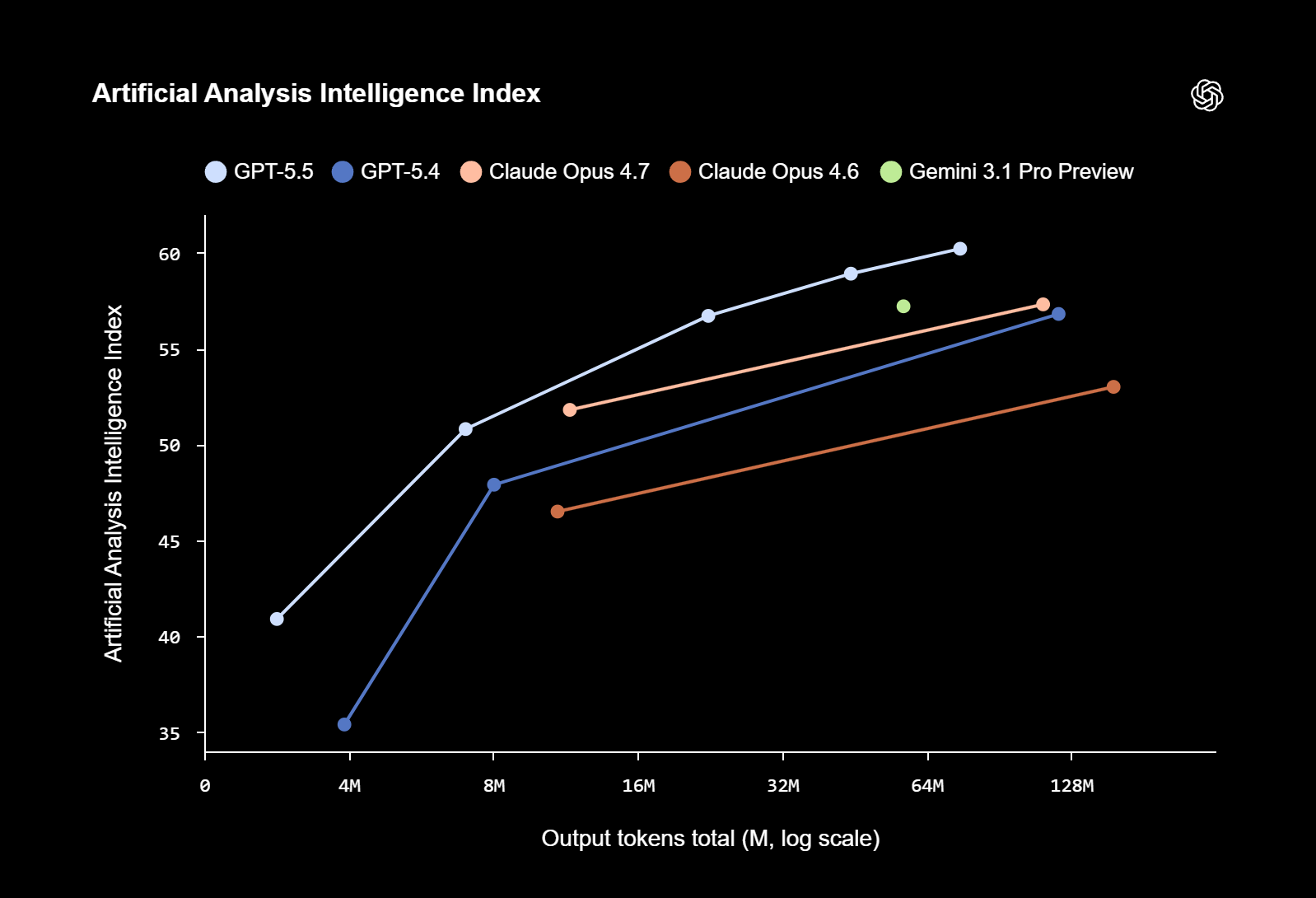
- • Same per-token latency as GPT-5.4, fewer tokens per task, higher benchmarks on agentic coding and computer use.
- • API pricing (once live): $5/M input, $30/M output — about 2× GPT-5.4's $2.50/$15.
What Ships Today (and What Doesn't)
GPT-5.5 is ChatGPT-first, API-later — a deliberate break from the GPT-5 and GPT-5.4 playbook, both of which shipped with same-day developer access. That single fact tells you more about OpenAI's safety posture this cycle than any number in the benchmark table.
- ✓Available right now in ChatGPT Plus, Pro, Business, Enterprise.
- ✓Integrated into the Codex desktop app for agentic coding sessions.
- ✓No API, no Azure OpenAI Service listing, no SDK updates yet. That's intentional.
- ✓Reports of a "Pro variant" codenamed Spud with extended reasoning, matching the existing GPT-5.x base/Pro pattern.
GPT-5.5 is the first GPT-5.x model that shipped to ChatGPT before the API. Read that as OpenAI saying: the thing got meaningfully more capable in the domains that worry us.
Where 5.5 Fits in the GPT-5 Family
The GPT-5 line has been an unusually noisy release cadence. Every three to four months OpenAI has shipped a new numbered variant — each building on a shared routing stack (fast + thinking + router) rather than a clean-slate rebuild. GPT-5.5 is the first one that resets the base model itself.
| Date | Model | What changed |
|---|---|---|
| Feb 2025 | GPT-4.5 | Last fully retrained base before now — research-preview frontier model. |
| Aug 2025 | GPT-5 | Unified system: main + thinking + real-time router. Safe-completions framework. |
| Nov 2025 | GPT-5.1 | Adaptive reasoning effort, apply_patch + shell tools, developer focus. |
| Early 2026 | GPT-5.2 / 5.2-Codex | Tool-use robustness, better long-context handling, coding + spreadsheets. |
| Feb 2026 | GPT-5.3-Codex | High-capability cybersecurity + bio classification. Strong OSWorld + GDPval. |
| Mar 2026 | GPT-5.4 / 5.4 Pro | Default frontier. 1M-token context, built-in computer use, compaction. |
| Apr 2026 | GPT-5.5 | First full retrain since 4.5. Agentic coding + computer use, same latency, fewer tokens. |
Trained on Nvidia GB200 and GB300 NVL72-class hardware. Pretraining completed Q1 2026.
Benchmarks: Where 5.5 Actually Wins
The headline numbers are incremental on paper, meaningful in practice. Single-digit percentage gains, but concentrated in the benchmarks that map closest to real agent work: terminal automation, desktop computer use, and cross-document knowledge work.
Terminal-Bench 2.0
82.7%GPT-5.5 · CLI-heavy agent workflows (up from 75.1% on 5.4, Claude 4.7 at 69.4%)
OSWorld-Verified
78.7%GPT-5.5 · desktop computer use (up from 75.0%, edges Claude 4.7 at 78.0%)
SWE-Bench Pro
58.6%GPT-5.5 · real GitHub issues (up from 57.7%, still trails Claude 4.7 at 64.3%)
GDPval (OpenAI variant)
84.9%GPT-5.5 · knowledge work across 44 occupations
BixBench
80.5%GPT-5.5 · bioinformatics (big jump over 5.4)
GeneBench
25.0%GPT-5.5 · genetics (up from 19.0% on 5.4)
Translation: if you're running agents in terminals or operating desktop apps, 5.5 is the strongest model you can buy. If you're resolving GitHub issues end-to-end, Claude is still the play.
GPT-5.5 vs Claude Opus 4.7 vs Gemini 3.1 Pro
| Dimension | GPT-5.5 | Claude Opus 4.7 | Gemini 3.1 Pro |
|---|---|---|---|
| Coding (SWE-Bench Pro) | 58.6% | 64.3% | — |
| Computer use (OSWorld) | 78.7% | 78.0% | — |
| Context window | ~1M (unconfirmed) | 1M | 1M–2M |
| Primary ecosystem | Microsoft (M365, GitHub Copilot, Azure) | Bedrock, Vertex, Foundry | Google (Vertex, Gemini CLI, NotebookLM) |
| Multimodal surface | Text + image (parity with 5.4 assumed) | Text + image | Text + image + audio + video |
| Safety posture | Stricter cyber classifiers | Standard Anthropic policy | Standard Google policy |
Highlighted cells = category leader on that row.
Where GPT-5.5 leads
Desktop computer use (OSWorld-Verified), terminal automation, tight integration with Codex + Microsoft 365, Azure governance controls. If you're building an enterprise agent that touches SaaS UIs, this is your model.
Where Claude still wins
Deep IDE coding. SWE-Bench Pro, Cursor workflows, large-codebase refactors. Anthropic's ~6-point lead on SWE-Bench is real and 5.5 only closed a fraction of it.
Where Gemini is different
Native multimodal (audio + video), 2M-token contexts, and NotebookLM-style research tools. If your workflow is data + media, not code + OS automation, 5.5 isn't obviously better.
Source : https://openai.com/index/introducing-gpt-5-5
What It's Actually For
OpenAI is not-so-subtly rebranding GPT-5.5 as a work-doing model, not a chat model. The marketing page copy is about "coding, research, and data analysis." The benchmark emphasis is on tasks that require the model to plan, use tools, and verify its own output. Concretely, here's where it pays off.
🧑💻 Agentic coding with Codex
Multi-step tickets — reproduce, patch, test, document — where the model stays on-task over hours. OpenAI's own teams use this for bulk refactors and review pipelines.
🖥️ Desktop automation
Spreadsheets, presentations, internal SaaS dashboards. OSWorld-Verified leadership is real. Good fit for finance ops, compliance, back-office.
📚 Research + synthesis
Long documents, cross-source analysis, structured briefs. Fewer tokens per equivalent task = lower effective cost on data-heavy pipelines.
🧬 Scientific workflows
BixBench and GeneBench jumps suggest real gains for bioinformatics and structured scientific tasks. Still requires human review in regulated settings.
✓ Pros
- •Leading score on desktop computer-use benchmarks.
- •Same latency as 5.4, fewer tokens per task — lower cost per completed workflow.
- •Drop-in into the existing GPT-5 routing stack (reasoning effort, tool search, compaction).
- •Tight Codex integration means less prompt engineering, more task design.
- •Conservative safety posture with expanded red-teaming (~200 external partners).
× Cons
- •No API for the first few weeks — ChatGPT/Codex only.
- •Still trails Claude Opus 4.7 on SWE-Bench Pro by ~6 points.
- •Stricter cyber classifiers can over-reject legitimate security research.
- •$5/$30 per 1M tokens is 2× GPT-5.4 — token efficiency needs to compensate.
- •No dedicated system card yet. Architecture, parameter count, context window unconfirmed.
Pricing: More Per Token, Less Per Task
The per-token price is up. The per-completed-task cost is down. Those two facts sit uncomfortably next to each other in a procurement spreadsheet, but if OpenAI's token-efficiency claims hold up in your workflow, GPT-5.5 is cheaper than it looks.
GPT-5.5 API (once live)
Input
$5.00 per 1M tokens
Output
$30.00 per 1M tokens
vs GPT-5.4
2× higher per token ($2.50 / $15)
Token efficiency
Reports claim significantly fewer tokens per Codex task vs 5.4
Benchmark your workflow
Don't compare per-token — compare cost per completed run
If your agent loop takes 3× fewer tokens on 5.5 than on 5.4, you're paying ~33% less per successful task — even at double the per-token rate.
Safety Posture
This is the part to actually care about. GPT-5.5's delayed API access is driven by stricter classifiers around cybersecurity and continued high-capability classification for bio. OpenAI is signalling — in its deployment sequence, not just its press release — that 5.5 is more capable in domains it worries about.
The safety TL;DR
Red-teamed with ~200 external partners before launch.
Same GPT-5 safety stack: safe-completions, chain-of-thought monitoring, sycophancy reduction.
New on 5.5: stricter cyber-risk classifiers, expected to cause more refusals on security-related prompts.
Bio and cyber capability are the two areas where OpenAI has explicitly said "more capable = more guardrails."
EXPECT MORE REFUSALS. THAT'S THE POINT.
What We Don't Know Yet
UNCONFIRMEDOpen questions
- • Context window size. 5.4 was 1M. 5.5 is likely the same but not documented. Treat as assumption until OpenAI publishes a system card.
- • Architecture details. Parameter count, MoE vs dense, training data mix — all unpublished, same as prior 5.x.
- • Multimodal surface. No announced expansion beyond 5.4's text + image. Native video rumors pre-launch were not confirmed.
- • Microsoft + Azure rollout. No Azure OpenAI Service or M365 Copilot announcement yet. Expected to follow API availability.
- • GPT-5.5 Pro. Referenced in reporting as "Spud" with extended reasoning, but not independently documented.
Verdict
Should you switch?
- ✓Building an agent that drives a desktop or terminal? Yes — this is the strongest model available for those tasks right now.
- ✓Resolving GitHub issues end-to-end? Not yet. Claude Opus 4.7 is still 6 points ahead on SWE-Bench Pro. Wait for the next Claude bump or run both.
- ✓Live in Microsoft 365 / GitHub Copilot? You'll get 5.5 automatically when it lands on Azure. No action needed.
- ✓Need the API today? Wait. GPT-5.4 or Claude 4.7 via Bedrock/Vertex are your options until OpenAI flips the switch.
- ✓Cost-sensitive? Benchmark per-task, not per-token. If your workflow streams long outputs, 5.5's token efficiency may offset the 2× per-token rate.
GPT-5.5 is not a vibe shift. It's a tightening. A denser base, cleaner routing into Codex, stricter cyber guardrails, and a deployment sequence that tells you OpenAI thinks this one matters more than the three versions before it. The headline benchmarks are single-digit wins. The operational story is bigger: this is the model OpenAI wants running your company's weekly report, not your weekend Discord bot.
Call it what it is: GPT-5.x finally leveling up to its own marketing.