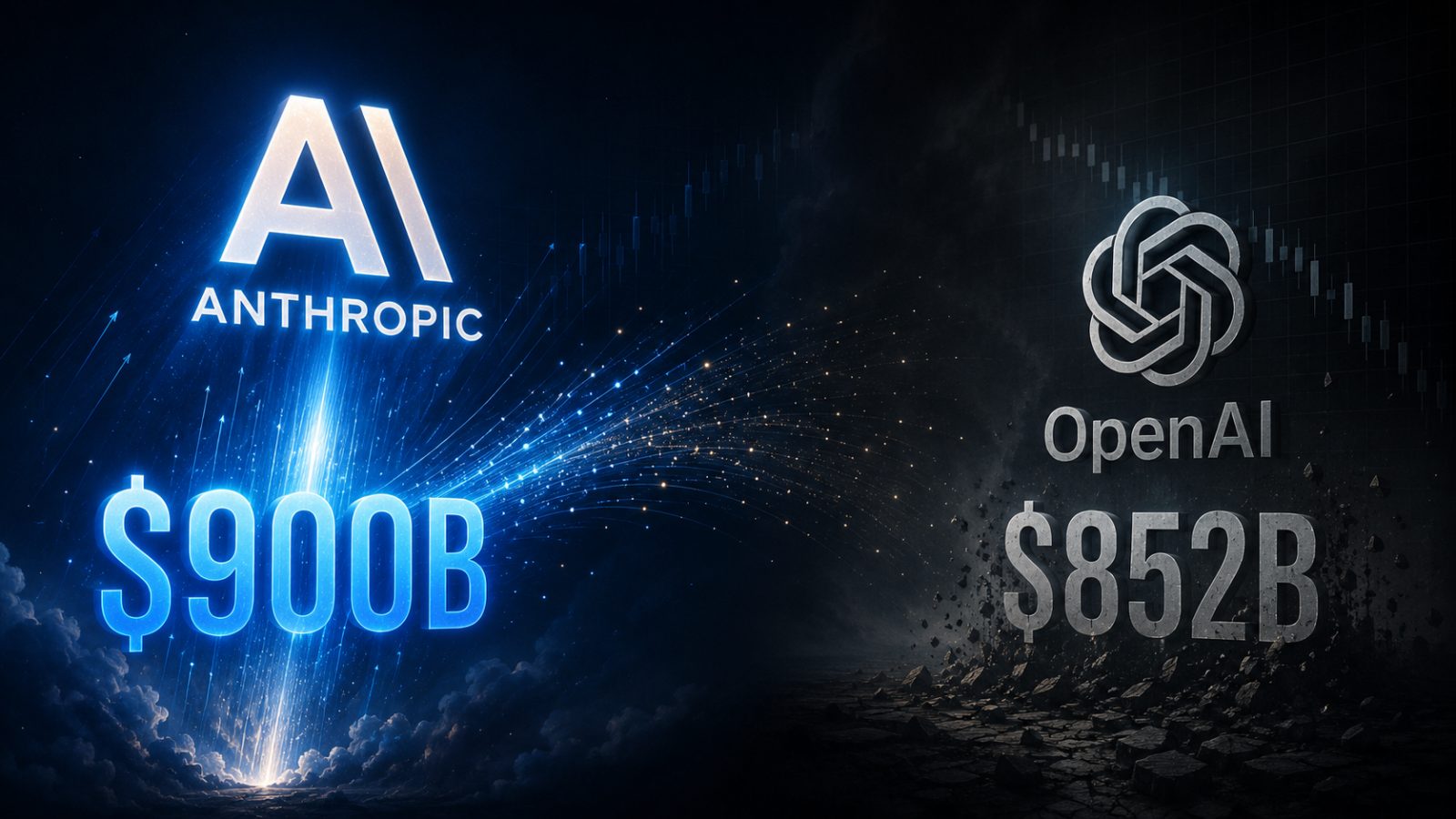
Twenty-four hours in late May 2026 rewrote the map of artificial intelligence. Anthropic closed a $30 billion funding round, pushing its valuation to $900 billion and past OpenAI for the first time. DeepSeek made its aggressive price cut permanent, dropping output tokens to $0.87 per million. And NextEra Energy spent $67 billion to control the power grid that every AI data center depends on. Here is what actually happened and why it matters.
Quick Navigation
Anthropic Hits $900B Valuation and Hires Andrej Karpathy
Anthropic closed a $30 billion funding round on May 25, 2026, valuing the company at $900 billion. That number officially surpasses OpenAI's $852 billion valuation. The company is now projecting $10.9 billion in Q2 revenue and its first-ever operating profit. Leadership is targeting $50 billion in annual recurring revenue within 18 months. These are not projections from a pitch deck. These are numbers grounded in actual enterprise contracts and API consumption data.
The more interesting move happened quietly alongside the funding announcement. Andrej Karpathy, one of the most respected figures in machine learning, left OpenAI and joined Anthropic's pre-training team under Nick Joseph. His mandate is explicit: use Claude to accelerate the very pipelines that create Claude. This is recursive improvement in practice, not theory. If it works, future versions of Claude will be built faster and with less human overhead than anything before them.
DeepSeek's Permanent 75% Discount Is Crushing Western AI Pricing
DeepSeek made its promotional discount permanent on the V4-Pro model. Output tokens dropped to $0.87 per million, down from $3.48 one month earlier. That is a 75% price reduction that is now the floor, not a limited-time offer. To put that in perspective, GPT-5.5 sits at $10 per million output tokens. Claude Opus 4.7 runs $25 per million. DeepSeek undercuts the leading Western models by factors of 11x and 29x respectively.
The pricing is not the only advantage. The V4-Pro architecture operates at roughly one-quarter the single-token compute load and one-tenth the memory footprint of its predecessor. For developers building agentic systems that make thousands of API calls per task, this is not a marginal improvement. It changes the economics of what you can build and ship. A workload that cost $1,000 last month now costs $75. Teams are already re-architecting applications around this new cost baseline.
The $67B Power Merger That Will Decide AI's Physical Future
While the AI labs fought over valuation and pricing, NextEra Energy acquired Dominion Energy in a $67 billion all-stock deal. The transaction carries a 21% premium for Dominion shareholders. The combined entity now controls 110 gigawatts of active generation capacity and a 130 gigawatt large-load project pipeline. This is not abstract infrastructure news. This is the physical layer that determines whether any AI company can actually run the data centers it promises.
Dominion sits atop Northern Virginia's Data Center Alley, which houses over 25% of the world's data centers. The connection queues in that region already stretch up to eight years. New AI facilities are waiting nearly a decade for power. Whoever controls the grid in that corridor controls the bottleneck for the next generation of AI infrastructure. NextEra just bought that bottleneck outright.
Claude Mythos Found 10,000 Vulnerabilities in One Month
Anthropic's Project Glasswing, using an unreleased model called Claude Mythos Preview, scanned open-source projects and delivered results that should make every security team uncomfortable. In a single month, it found 10,023 total findings, including 6,202 critical vulnerabilities. The confirmed true positive rate sits at 90.8%. That is not a benchmark. That is a real audit of real code with real bugs.
Cloudflare ran its own parallel study and uncovered 2,000 bugs, with 400 classified as severe. Mozilla patched 271 Firefox vulnerabilities directly attributed to AI-assisted review, a tenfold increase compared to what Opus 4.6 found. Claude Mythos also solved both UK AI Security Institute end-to-end multi-step cyberattack simulations. The model did not just flag individual issues. It traced attack chains across entire systems.
The research validates something the security community has suspected: prompt injection is not a content problem. It is a system integrity problem. Eleven real-world attacks on commercial AI agents were documented in new research, targeting Claude Code, Microsoft Copilot, and the Cursor IDE AgentFlayer attack. When an AI agent can be redirected through injected prompts, you do not have a chatbot. You have a compromised system with elevated permissions and network access.
The Viral Coding Agent Running at 99.82% Cache Hit Rate
On the developer side, one repo is dominating GitHub and Hacker News. The esengine/deepseek-reasonix project is trending because it achieves 99.82% cache hit rates through byte-stable prefix caching. That number sounds academic until you see what it means in practice. A 435 million token daily workload that cost $61 last week now costs $12. That is a cost reduction most companies would kill for, and it came from a caching strategy, not a new model.
The project pairs with an Unabyss context memory layer that remembers exactly what tokens were sent in previous requests. Standard caching fails when tiny whitespace differences or tokenization drift produce different hashes for the same logical prompt. Byte-stable prefix caching solves this by treating semantically identical inputs as identical regardless of micro-variations in how they were constructed. For general context window management, this is a meaningful improvement that developers building AI agents should understand.
Microsoft released SkillOpt the same week, and the results are striking. SkillOpt achieves best or tied-best performance across 52 benchmark settings using text-space optimization instead of parameter weight updates. The system does not fine-tune the model. It optimizes the prompts and response formats themselves. For teams that cannot retrain models but need better performance, this approach is worth studying.
ASUS Wants to Run 35B Models on Your Laptop
ASUS announced a hybrid AI architecture that integrates Phison's aiDAPTIV memory extension technology across its commercial lineup. The pitch is direct: run 26B to 35B parameter models locally with up to 70% cost reduction compared to cloud API calls. This is not a concept demo. It is shipping hardware that extends what consumer-grade machines can handle. For developers building applications that cannot send data to external APIs due to privacy, compliance, or latency constraints, this changes the viable local context. You no longer need a data center to run a capable model. You need a well-configured workstation with the right memory architecture.
Why Your AI Coding Agent Falls Apart on Complex Backends
New research on constraint decay explains something every developer building AI agents has noticed. Frontier models lose an average of 30 assertion pass rate points when operating under dense architectural constraints. The models perform well in isolation. They degrade significantly when asked to reason through layered systems with interdependent rules. Data-layer defects account for 45% of agent logic failures. The model is not stupid. It is working with insufficient general context about how the system it is modifying actually behaves under load, under concurrent access, or across edge cases that do not appear in documentation.
SkillOpt's text-space optimization approach sidesteps some of this by finding better prompt structures rather than relying on model weight updates. But the deeper issue remains: agents need richer system context to operate reliably in complex environments. The esengine/deepseek-reasonix caching strategy helps by reducing token costs, which means you can afford longer context windows with actual architectural details. For builders, the lesson is practical. Do not assume your agent understands your backend. Show it. Feed it schema, dependency graphs, and failure mode documentation as part of every task. The model is capable. The general context you provide determines whether it succeeds.
What This Week Actually Means
- ✓Commoditization is here. DeepSeek's permanent price cut to $0.87 per million tokens is not a promotional tactic. It is the new floor, and it forces every Western AI company to compete on factors other than raw cost.
- ✓Security is broken. Claude Mythos found 10,000+ real vulnerabilities in one month with a 90.8% true positive rate. Prompt injection is a system integrity issue, not a content filter problem. If you are deploying AI agents in production without a security review, you are already compromised.
- ✓The real bottleneck is power. NextEra's $67B acquisition of Dominion was the most consequential AI story of the week, but it got the least coverage. No compute, no models, no agents without electricity. The companies that secure power infrastructure will determine the pace of everything else.